Why We Fight
I won a first place award in Sports Journalism from the New England Newspaper Association in 2000, for an article that I wrote about ultimate fighting for The Boston Phoenix. The Phoenix won a big award for overall excellence that year, because so many the staff placed in the competition. But in the paper’s own write-up, mine was the only article to be credited as an “account” of its headline— “Michelle Chihara scored top marks in Sports Writing, for her account of Total Kombat” —with no link to the article.
My own paper made it sound like I had recapped a videogame.
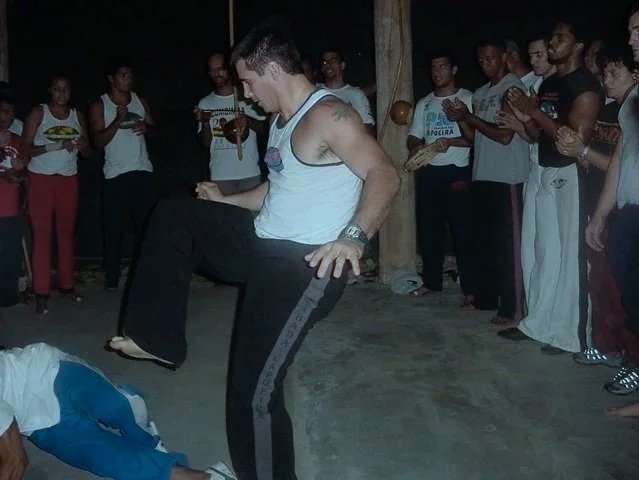
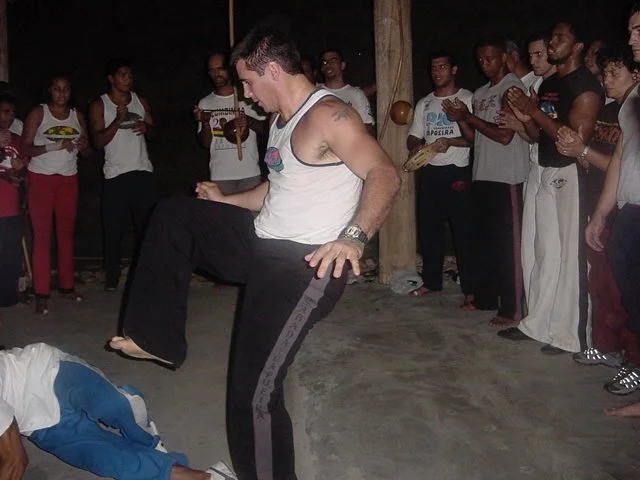
Capoieristas in Brazil, many of whom trained in jiu jitsu, here at Mestre Abadá’s school. The man in the center is Mestre Cobra, if memory serves. I found mixed martial arts through capoeira.
The Phoenix always seemed vaguely uncomfortable about me, as a writer. But ultimate fighting was never just a game, and my piece was a solid feature about the cultural history of mixed martial arts.
I even got myself invited to a no-holds-barred underground fight in New York. But it got canceled, rather dramatically, just before I was set to attend. I can still remember standing at my desk at the paper, crestfallen, after getting the phone call about the police shutting down the entire ring. My editor told me to go ahead with my article. I still had the in-depth profile of an undertaker who only fought underground. I published my piece, and I won the award.
I still wish I had held out for another true cage match.
My piece explored masculinity, its pressures and paradoxes, and the history of the fights. I looked at the roots of the Ultimate Fighting Championship, when it was still scrappy and unknown, before the reality TV show The Ultimate Fighter truly popularized the sport in the US. Back then, I was a newspaper reporter covering a subculture that was still largely secretive and illegal.
Today, the fights are the backbone of a multi-billion dollar corporate media entity. In fact, one TKO’s leading executives believes that he can see the day when “the whole media section is gone,” by which he means, the day when UFC media won’t have to deal with reporters from independent outlets at all. He told Forbes that someday soon it will just be income from fights and social media, “it’s gonna be all about the influencers.”
The exec is correct that journalism is now an endangered species. My piece was written for an alt weekly that, at the time, seemed to own Boston. It was hard to imagine it would go away. The paper paid me to report and then hired a fantastic freelance photographer to take pictures. Today, the Phoenix’s archives, unindexed and fading away, don’t even seem to have the copy for the piece anymore. The photographs are long gone. The words exist only in the janky downloaded file on my hard-drive (and now below).
To today’s UFC, the demise of journalism looks like a win-win. The executive boasts gleefully about all the marketing work that social media users do for free, puff coverage in exchange for access. Ironically, this kind of light touch press, in exchange for access, is one of the reasons that people lost faith with the legacy media in the first place. The shift to influencers raises questions at the intersection of labor and culture: Who’s committed to the truth, and why, and who gets to make a living covering sports? Who gets a platform to do thoughtful, fully-reported, fact-checked work?
Ultimately, I think, Ultimate Fighting will suffer from the loss of a healthy media ecosystem, but also, The Phoenix’s top editors were never entirely sure they wanted to give me that platform, either. Did a girl get to be thoughtful about serious, masculine topics? Unclear. My editors at The Phoenix didn’t pay me or treat me the same as the guys. To oversimplify a bit, the paper was a tough place to be femme. That’s part of why I left (I moved to Brazil for a year and then eventually went to grad school). My spidey sense was telling me this UFC thing was a bigger story than the paper was giving me credit for. My spidey sense was also telling me that there was no path forward for me at the paper. I felt those things in my gut. I certainly did not know that the UFC would get sucked into an asteroid of toxic masculinity that would threaten to destroy US democracy, while the Phoenix and everything it represented, good and bad, would disappear almost entirely.
An increasing number of MMA gyms, of the exact type that I covered, now serve as fronts for clubs within a “national and international neo-Nazi network used to radicalize members, promote extremist ideology, and train for coordinated violence.” That’s what I mean when I say toxic masculinity; I’m ready to draw the line at white supremacy. I say this, however, because the fighters, the gyms, and the spaces I was writing about in 2000 were not, on balance, toxic. They were full of people who were trying to work out extreme feelings and violent impulses. But at its best, no-holds-barred fighting was a cocky, dangerous, anti-authoritarian collective. Fighters wanted the autonomy to take on the risks and challenges that they deemed worthwhile. They were also highly-disciplined, and outside of the cage, some had created a respectful community, and could be a lot of fun.
There’s no bright line between violently-toxic and productively-channeled masculinity. The fights were unquestionably masculinist and centered on masculinity, and as a young woman, I had to find ways to use being femme to my advantage in those spaces. Gender creates not stable identities but shifting demands for certain kinds of performances. Sometimes, I had to bat my eyelashes and ask powerful men to explain things to me, even though I already understood them. Sometimes I had to flirt a bit to get what I needed, while meeting sources in well-lit public places. Did I meet my star source for the fight piece in a bar? One hundred percent. Did he do a better job telling me the stories of his exploits because it kind of felt like a date? Maybe. We still fact-checked it all, at the paper. And I’m ready to vouch for my fighting Irish undertaker. He was a gentleman, to me. He was a white guy in gyms with a lot of men of color, and he was avowedly equal-opportunity. He wanted the purity of the challenge, no fish-hooks, no blows to the spine, no other rules. If he was psyched to talk to me because I was a girl, it was because I was also a girl who listened with respect. And he, in turn, respected the skeptical and feisty POV that the alt-weekly world was once so good at.
The excellent reporter and cultural critic Pablo Torre recently did a piece on the strange story of a tickling incident in the UFC cage. Torre does the kind of incisive and investigative work that we aspired to back at The Phoenix; he likes to say that sports are a liberal arts education. He and PJ Vogt, in his version of the story with Torre on Search Engine, both touch on masculinity. They talk about its paradoxes in light of MMA’s promise to contain violence within socially acceptable venues. But there’s still a kind of unspoken assumption that fighting, or that masculinity itself, is about how men are among men. When one fighter changes the trajectory of a fight by tickling his opponent, the question Torre raises is, what happens to the world of hypermasculine men when one of them appears ticklish?
Ticklishness, which we associate with kids and playground games, does put an interesting twist on the idea of a pure fight. But I was struck by how much I agreed with the people from the fighting world when they told Torre that they just didn’t think that the tickling was a big thing. The people making hay of the tickling, in other words, seemed to come from outside of the fight world, online. I think Torre is pretty much the most thoughtful sports writer out there. But on this issue, I could relate to the fight bros who were like, yeah… we just kind of want to stop talking about this.
When I covered fighting, I was training capoeira with guys who did Gracie jiu jitsu. I knew a lot of them, some of them intimately, and I took a few lessons myself, before and after the article. I grew up unathletic and relatively tiny, and I got bullied occasionally. I got stronger in capoeira. In jiu jitsu, I learned a couple of grappling moves and then went up against someone heavier and better trained. Being a young woman means coming up against the threat of physical violence all the time. Still, there is no experience of your own vulnerability like actually trying to fight. I could relate to the young men who responded to that sense of vulnerability by trying to rise above it at the gym, by bulking up and leaning into their aggression. I couldn’t say it out loud in my piece, at The Phoenix, but I was writing about fighters because I saw the allure.
Now I can say it out loud: I kind of wanted to fight, and there are women who fight. In 2000, I wrote: “Ultimate fighters seem not to be people whom society has handed a golden ticket. They're not like the protagonists in the movie Fight Club—white-collar yuppies who are fed up with the emptiness of an Ikea-as-identity culture. They seem, primarily, to be people searching for something—validation, sense of self—who have found it only in the cage.” Notice I did not say “men.” As a young reporter at the turn of the millenium, I was also on that search for validation and a sense of self. And much later, I was still interviewing fighters.
In 2023, I spoke with the brilliant Jenny Liou about her book Muscle Memory. Liou was in grad school with me when she began training seriously in mixed martial arts. Later she wrote a series of poems about identity, motherhood, family, and fighting. Jenny only broke an opponent’s bone when the other woman tried to cheat her way out of a submission hold in the ring.
In my twenties, right around the time I was reporting for “Total Kombat,” I found a classified ad: An anonymous donor wanted to pay two women to fight for him, on videotape. I emailed the person.
At the paper, I was under tremendous social pressure to be the right kind of girl reporter. I had to conform to the norms of being available but not needy, pretty but not slutty, cool but not a bitch—while also somehow competing with my colleagues for the cover story. Those pressures, and the rage I sometimes felt, gave me insight into the urge to step into the cage. But I was also drawn to fighters as a young, straight lady. I also saw the appeal of dating men who tried to pay for dinner and promised to protect me.
I was briefly with an MMA-trained athlete who had been in a number of bar fights. He had come out of all of them relatively unscathed. He told me, in a rare vulnerable moment, about how dudes in bars sometimes responded to his confidence as a challenge. It was as if he projected an air of not-caring, and this made some other men, especially when drunk, want to fight. He had once seriously injured an opponent with a broken bottle. I felt quite safe with him, it’s true. I later realized that this was mostly because he was by then totally uninterested in fighting at the bar. He was ready to leave any bar as soon as the vibe went south. He was secure in his ability to win certain smarter fights, and thus, he really, really didn’t want to get into dumb ones anymore.
The young Brazilian fighter I interviewed at the end of my article insisted, while his girlfriend wept openly, that he was fighting “for her.” That was the last thing she wanted. But as an underpaid immigrant, he could see no other future, no other way to be a man. The cage seems most dangerous when it turns into this kind of unreachably pure goal, when its metaphorical position starts to collapse into some kind of authentic test of manhood.
Jenny seems to have a reasonable hold on fighting as both an incredibly badass thing to do and as something distinct from her inherent worth as a human. That’s not just because she’s a woman, though. For a variety of reasons, she has a full life with a solid foundation, mental and physical, from which she can keep fighting in its metaphorical place. Whatever the rules, tickling or no, the people who win in the cage would most likely win “in real life.” Man or woman, if you’re not trained, I would highly recommend not trying to fight Jenny. There’s also no way Jenny would step into the ring with a much heavier and/or better-trained opponent, not because she’s a coward or not a “real woman” but because that would be dumb. It’s when the UFC starts to seem like the best available path—or the only path—to being “a real man” that the distinction between being a good fighter and being the right kind of person gets muddied.
The UFC is unquestionably cozy with the manosphere, a toxic media space that’s increasingly reactive and reactionary. None of that is good for our democracy or culture writ large. But the fights are neither inherently toxic nor inherently manly. A healthier media ecosystem with more thoughtful reporters (like Torre) would help us understand our need to fight. But also, it doesn’t matter how the media represents them, if, like young Luciano in my piece, fighters are drawn to the cage because they see it as their only option. Fighters aren’t dangerous because they have trained, I would even argue that it’s not the best fighters who are the most dangerous. The danger comes when the culture more broadly loses the boundary between the fight and the world, the cage and the rest of life. My ex saw quite clearly that the real world is almost never a level playing field where the best man wins. That’s why he found fighting appealing, it was a clearly demarcated space of extreme risk and reward. He had not lost the metaphorical thread and forgotten to be human first. He might have started fighting because he felt cornered in life, but he had used the training to learn not to lash out.
I almost agreed to fight another woman for that creepy classified. It was a lot of money, at a time when I was scrounging to make rent at the end of the month. But then the fight seemed too dark and too fetishized, and I hadn’t trained enough. So I sold everything I owned and moved to Rio de Janeiro instead.

Full Contact Fighter interviewed me on the radio, and gave a better summary of the piece
Total kombat
The grassroots world of Ultimate Fighting
by Michelle Chihara
[originally published in The Boston Phoenix, 8/3/2000]
Frank Black's mother is standing with the palm of her hand pressed to her chin, her fingers covering her mouth as if to keep herself from crying out. "This is like high school," she says, shaking her head, "like when he played sports in high school."
Inside a hangar-like garage in Pawtucket, Rhode Island, her son is about to compete before a crowd of 700 people, including about 70 of Frank's friends, co-workers, and gym buddies, as well as his mom and his wife, Tracy.
This is not high-school football, or even boxing. Black is the 12th fight on the card in a sport called vale tudo, a Portuguese phrase meaning, unfortunately for Frank's mom, "anything goes."
The lights go down and a door flies open behind the ring. Frank Black appears framed in smoke from a fog machine, his cadre of fans scream Frankie!, and a thudding bass line follows the MC's introduction. Black enters the ring and strips down to his trunks. At the call "Fight!", he squares off against Pierre Gouillet, a lanky fighter with a tribal tattoo across one shoulder.
"Oh God," his mother says. "I gotta talk him into taking up golf."
Thirty-four seconds later the fight is over. After a flurry of blows, Gouillet executes a quick takedown and pins Frank Black in a submission hold with his elbow hyperextended; Black, helpless, taps his free hand on the mat to signal that he submits. He gets off easy: he has taken few blows -- as they say in vale tudo, very little punishment. He has not, like a fighter in tonight's first middleweight match, been straddled by his opponent and had his head whacked into the mat until blood was gushing from his nose, with the ref calling out, "Hit the gong, hit the gong!"
Black walks away shaking his head. His mother exhales and lets her hand fall to her side. "He caught him with a good kick, Tracy," says one of Frank's buddies, comforting Frank's wife.
"Yeah." She almost laughs. "But he's gonna be all fired up now, and he's gonna want to do another one."
Fight fans call it pure. Promoters call it "no holds barred." Critics call it gladiatorial violence. Massachusetts calls it illegal, which is why a Brockton guy like Frank Black is traveling down to Rhode Island to compete.
Vale tudo is basically the local amateur circuit of ultimate fighting, a combat sport you may have seen or heard about in the early '90s. Like its participants, ultimate fighting came on big and then lost big -- in 1993, it was a heavily promoted sport advertised as a bloody spectacle with "no rules," but within a few years, opposition from parents, Congress, and boxing commissions had relegated it to the status of a sideshow on the fringes of pay-per-view cable TV.
At the grassroots level, however, the sport caught on, even though fighters in the US know that big purses are scarce, even on the professional circuit. Only Japanese fights award huge prizes. For the most part, these guys are in it for the thrill of the fight. They vary in height, weight, and race; most are (unsurprisingly) young, with shaved heads and tattoos.
Promoters these days tend to leave the garish term "ultimate fighting" to the professional league, the Ultimate Fighting Championships (UFC), instead referring to the sport as "mixed martial arts." (A sport of many names, it's also called "submission fighting," since fights tend to end when one opponent gives up; "extreme fighting"; and "no-holds-barred fighting.") Like Frank Black, who has a background in Muay Thai kickboxing and a Brazilian version of jujitsu, its competitors are usually trained in one or two martial arts -- judo, jujitsu, Greco-Roman wrestling, boxing, kickboxing, karate, tae kwon do. They're matched according to fight experience and weight.
There are also a few rules, although just how many rules depends on the organizers of each tournament. At the vale tudo tournament in Rhode Island, fighters are not allowed to hit each other with a closed fist -- it's open-palm strikes only. Chokeholds are fine. But they cannot gouge each other's eyes, bite, kick a downed opponent, hit the opponent in the throat, or do something called "fish-hooking," which consists of sticking your thumb in somebody's mouth and pulling.
“LAST LEGS: Luciano DeOlivera, 22, a Brazilian immigrant and talented grappler, lost this fight out of pure exhaustion.”
The list is not long, but it is meaningful: moves and blows with a higher-than-average chance of causing paralysis, death, or serious damage are not allowed. For a sport concerned on all levels with legitimacy, seriously damaged or dead competitors are not an asset.
THE MC of the Pawtucket fight is Kipp Kollar. Sales director for a medical scanning company by day, Kollar is the president and founder of the North American Grappling Association and the man responsible for introducing much of New England to submission fighting. He looks a little bit like the Joker. He sports a golden tan and a shining shaved pate, and he smiles a lot -- a sudden, brilliant, pointed grin.
Kollar loves ultimate fighting because it's "exciting" and "realistic," and because "it really works."
"A lot of wrestling and boxing matches go to the time limit, and then how do you pick a winner?" he asks. Ultimate fighting, in contrast, is usually crystal clear.
Clear, and sometimes brutal. For fight fans, part of the excitement is undeniably rooted in blood lust. In Pawtucket, the crowd cheers loudest for the big, heavy blows, and one man cheers a prolonged leg bar by shouting, "The pain! The pain!"
An official of the UFC calls ultimate fighting "the perfect blend of sport and spectacle," and points out: "A lot of fans watch auto racing and boxing and hockey to see blood. Whether it's our instinct or blood lust, who knows? But it's true for all sports."
For the fighters themselves, however, the appeal is different. It's about how their discipline measures up.
The Ultimate Fighting Championships were born in 1993, when Rorion Gracie walked into the offices of the Semaphore Entertainment Group in New York City with a videotape of Gracie victories in Brazil. The Gracies are Brazilian fighting superstars who had taken an established Japanese grappling discipline -- jujitsu -- and put their own spin on it, increasing the emphasis on joint manipulations and submission holds. The Gracies had issued open-door, winner-take-all challenges in Brazil, daring any fighter to beat them in open fights with no rules. Almost no one could.
No one at Semaphore had ever heard of the Gracies, but Rorion's videotape looked like the pay-per-view hit they needed. Rorion's younger brother, Royce, helped prove them right.
The first Ultimate Fighting Championships pitted sumo wrestling against French Savate kickboxing, Thai kickboxing against karate, and boxing against Royce Gracie. For that fight and for four tournaments to come, Royce Gracie blew just about everyone else out of the water. He would seem lost under a hail of blows, until he would reverse the fight all at once by pinning the other guy -- maybe a guy 60 to 90 pounds heavier than he was -- in a chokehold with his legs.
Gracie jujitsu proved itself almost as unbeatable in America as it had been in Brazil. Another of the brothers, Rickson, showed up in the US in 1993 with one of the typical Gracie challenges: $100,000 to anyone who beat him.
Kipp Kollar, who at the time had spent a decade teaching the graceful kicking arts of tae kwon do, remembers the shock. "We went there thinking were going to do well against this guy," Kollar says of himself and his martial-arts buddies. "And he smashed everybody."
One glimpse of Gracie was enough to set a generation of martial-arts buffs down a whole new path. The "strikers" -- the boxers and the acrobatic high-kickers -- can do damage. Kickboxing can beat sumo. But the real badasses, the people who could win in an ultimate-fighting ring, finish their fights on the ground.
"A karate guy throws one kick or punch," says Kollar, "and immediately gets taken down. The grappler throws some sort of submission moves, and -- think about a street situation, in a bar, a fight always ends up going to the ground. It's much more practical in a real-life self-
defense situation."
The consensus among mixed martial artists is that the best fighters are "well-rounded" fighters who know both a striking and a grappling art.
Showing them both off, though, can be difficult. In most states mixed martial arts is more or less illegal. Combat sports need licenses from athletic or boxing commissions. Most commissions banned true no-holds-barred fighting in the mid '90s, especially after Senator John McCain went after the sport for what he deemed its sick brutality. The UFC's early promotional campaigns, trumpeting the bloody-brute "two men enter, one man leaves" side of the fights, turned the sport into a political scapegoat for violence in society.
Organizers are just now starting to recover. They're working hard with the commissions in the hopes of getting sanctioning bodies across the country to license them. They've toned down the hype, instated new rules, and beefed up safety precautions. At least one huge market, California, is about to legalize the UFC.
“FIGHT CLUB: Frank Black lost his vale tudo match in 34 seconds, but he didn’t take the beating handed to some competitors (center). For Kevin MacDonald (bottom), these legal tournaments are a little tame. “The underground fights are never going to go away,” he says.”
But as this kind of fighting becomes legitimized as mixed martial arts -- a sport with governing bodies, commissions, and rules -- those drawn to its darker side are heading deeper underground. There are certain people, for instance, who do not consider the vale tudo in Rhode Island to be "true" no-holds-barred fighting.
"You'll hear guys talk, like on the Internet boards, about how much it's split into two groups," says Kevin MacDonald, a 25-year-old Watertown native who works as a funeral director in Boston. On one side are mixed martial artists in favor of legitimacy. On the other side, "You've got guys that are more like myself, in the sense of being in it for the pure form -- the `anything goes' sense."
An experienced fighter, MacDonald is a compact Irish guy with a crew cut and a puckish sense of humor. Ask him why he fights, and he'll say, "Because it's fun," with a devilish raise of his eyebrows. Then he'll laugh.
He's leery of promoters and money men and the other trappings of professional sports. "A lot of guys are saying we should just take the elbow out, work with the commissions," he says. "All that's going to happen is it'll get like boxing. It'll get watered down. You'll have complete professional fighters, where this is all they do. The promoters start making more money. Then you get your Don King, with no connection to the sport, throwing a fight, demanding all this money."
MacDonald isn't sure the sport he loves is destined for legitimacy: "The public is never going to accept things where there's a lot of blood."
With a background in Muay Thai kickboxing, jujitsu, and what he calls "freestyle grappling," MacDonald has a professional record of five wins, three losses, and one tie. He says he'll fight anywhere, anytime, any rules. He's also run with the bulls in Pamplona, twice. "This time I touched one of them on the ass," he says, laughing. "I'll do anything with adrenaline."
Including fight underground. The UFC may have trouble getting fully licensed, but the underground "no eye-gouging, no biting, end of rules" fights are outright illegal. MacDonald remembers being sent downstairs at an underground fight in Los Angeles because he and his opponent were "quite bloody" and the promoter needed to "make things look respectable" for the police, who had just arrived.
In another underground fight, in Houston, MacDonald's training partner Eve Edwards caught an opponent in a head clench. "[Edwards] was throwing knees into the kid's face," he recalls. "They stopped and checked to see if he was okay. He was bleeding a little, but they let him go back. And my buddy gets him in another clench, he's bombing knees. And then the kid just opened his mouth. It looked like he had taken a quart of blood in his mouth. And then three things fell out. I stared at 'em.
"Turns out he had split the kid's upper palate in half, and three of his teeth, it wasn't just the teeth that we were seeing. It was the entire root, everything. The promoter picked 'em up and put 'em in an empty cup and said, `Here, kid.' "
None of this deters MacDonald. "There are always going to be flukes," he says. "Look at how many guys will never walk again because of football. And this is one of the most intense exercises of the mind. `Where am I? Where is he? If I try this, will he try this?' "
For MacDonald, the fewer the rules, the truer the test. "I've done boxing, kickboxing, judo. Some guy'll win on something stupid, some point or whatever, and then he's jumping around like he's a badass. With this, you know when you won, you know when you lost. It's exciting."
Ultimate Fighters take on challenges the way other people climb Mount Everest: for the searing purity of the challenge; as a way to reach the irreducible conflict of man and obstacle. People watch ultimate fighting the way people watch movies about Everest expeditions. Half the motivation is the possibility of redemption, reversal, human victory against all odds. Half is the possibility of . . . cannibalism.
Ultimate fighters, in this light, are a fringe group who take society's logic -- that it's manly and good to be able to defend yourself in a fight -- to its logical extreme. And for the most part, society doesn't want to recognize the violence inherent in being "manly." Extreme sports are one thing. But society frowns upon true extremists.
"Anything truly exciting in this society is suppressed," MacDonald says.
Ultimate fighters seem not to be people whom society has handed a golden ticket. They're not like the protagonists in the movie Fight Club -- white-collar yuppies who are fed up with the emptiness of an Ikea-as-identity culture. They seem, primarily, to be people searching for something -- validation, sense of self -- who have found it only in the cage.
Luciano DeOlivera, 22, is a fighter who trains with Joao Amaral in Everett. Amaral fought, and won, his first American professional fight at the World Extreme Fighting tournament in June in Atlanta (his academy is called New England Brazilian Jiu Jitsu). DeOlivera is a Brazilian immigrant who works, sometimes, refilling vending machines. A talented jujitsu grappler, he lost his vale tudo match at the Pawtucket tournament out of pure exhaustion: he spent everything he had in the first few minutes of the match, a common mistake for first-time fighters.
DeOlivera's heel is swollen and distended, with a dark spot at the center. He's limping. But Amaral tells me, "Luciano will fight again. He'll be a good fighter." They're hoping he'll compete in September's tournament.
This comes as a surprise to DeOlivera's girlfriend, who's sitting next to him in the studio. Watching Luciano fight in Pawtucket, she says, was "awful."
"I was crying," she says. "I couldn't stay in my chair."
I tell DeOlivera she doesn't want him to fight.
"I know," he says. "But I have to do it for her. She doesn't respect me."
His girlfriend rolls her eyes. He laughs and squeezes her shoulders. "I have to prove myself," he says softly.
"Can't you prove yourself here?" she says, jutting her chin at the jujitsu students rolling around on the mats. "You can prove yourself here."
Luciano touches her hair, tenderly, and doesn't answer.
this blue angel