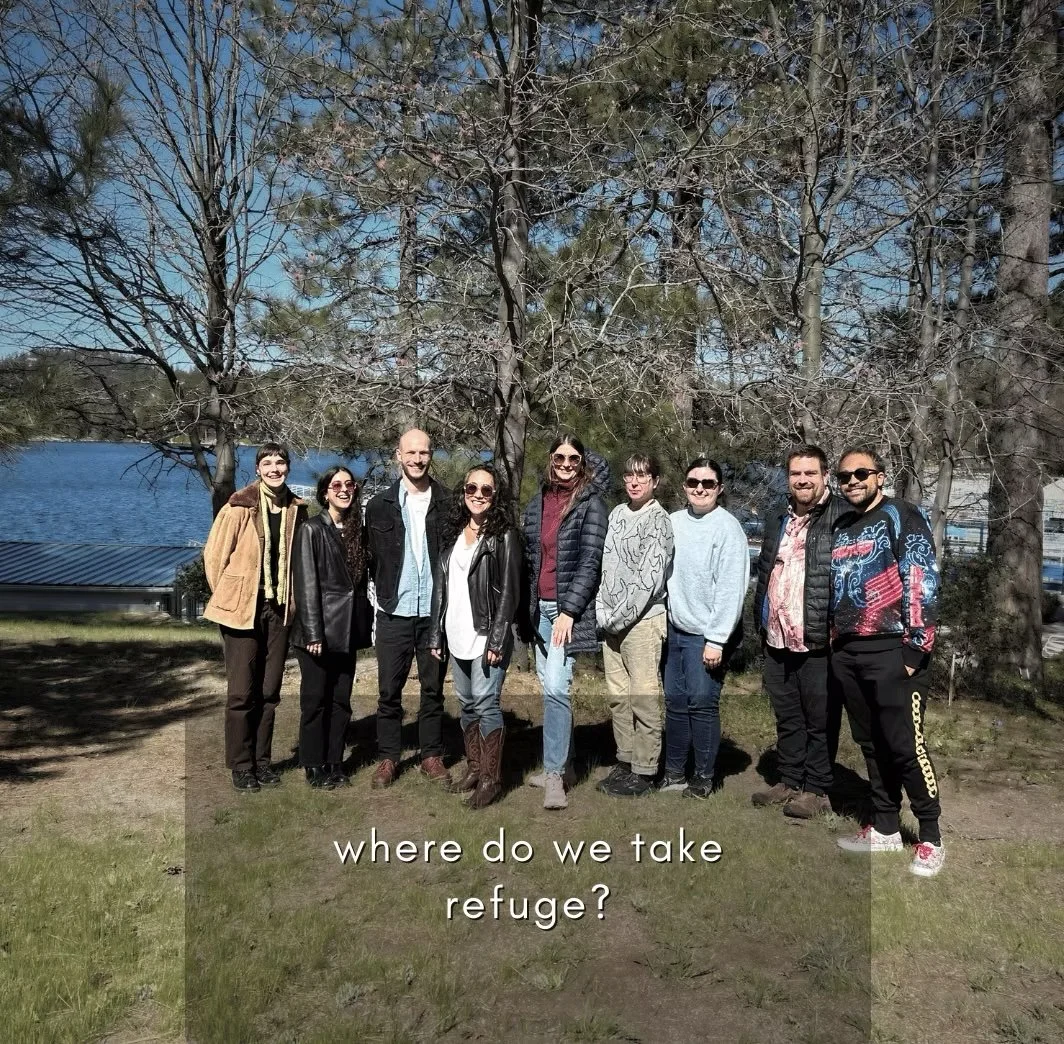
UCHRI graduate students with me at Lake Arrowhead
In April and May, I worked with a group of graduate student who had won competitive grants from the UC Humanities Research Institute to write public-facing essays on the theme of work and refuge. They participated in a larger set of initiatives exploring refuge and its refusals. After having met only once via Zoom for a workshop, we found ourselves together at the University of California's well-appointed lakeside vacation cabins. I have a suspicion that my presence may have been a kind of glitch in the budget. But however it happened, the graduate students opened their hearts to the process.
We played a game of Moniker, walked around the privatized lake, cashed a few bottles of wine from TJs and talked about their ideas. This stimulating set of conversations resulted in a series of luminous essays, now out on Foundry. The group has generously credited me, but I'm the one who should be grateful to them, not only for the experience, but also for giving me an excuse to carve out the time to read each piece in the series.
Writing is work. Especially as an editor and an instructor, I am exquisitely aware of how much it takes to envision and execute a good essay and of how that work is being devalued in today's landscape. I'm also exquisitely aware of the way that knowledge is created in epistemic communities. Oftentimes, the corporate university and extractive media systems use labor of love discourse to pressure scholars and writers into doing too much for too little. We become complicit in our own exploitation because we do love the work. And yet, sometimes supportive communities form, around a lake, like drops of water coalescing. It takes a lot of administrative attention and luck to give people the resources and the space they need. And yet. And yet. Sometimes you get lucky.
I can't do them all justice here, so go read all of these essays, but:
Rosie Dwyer's sound art, in her meditation on university labor in "Sounding Graduate Student Work," brought me into sharp, embodied awareness of my longing for human conversation.
Sammy Solis wrote about the impossible exhaustion of trying to separate the personal from the scholarly in always-already politicized spaces and places, in "Oversharing in the Academic Borderlands."
In "The University’s Two Bodies: Crip Labors of, and Beyond, Survival," Andrew David King links ableism to the constraints of a false Cartesian dualism in the space of knowledge production. He pushes against those constraints, in an effort to imagine a way of flourishing "that accounts for the desires as well as the needs of disabled and non-disabled bodyminds."
In " Whose “World” Is It? Global Educational Justice in the Age of Neoliberalism," Joshua Tan names the international universities' colonial tendencies and defamiliarizes its power structures. Side-stepping another false dualism, he gets outside of an easy "Brand USA"/"Bad USA" dichotomy to recognize an international scholarly community that wants to reclaim "the university as a space to reimagine more just futures."
In "Time to Go South: Memory Work and Political Dialogues from South America" Yuri Fraccaroli writes that"even the most disruptive and critical academic work relies on unequal relations of power." And yet. They encounter the bold and transgressive political work of a Black Brazilian trans activist, Neon Cunha, in its relevance to the current context. "By engaging with shared memories of dictatorship, violence, and disappearance, these activists transform the persistence of fascist ideologies into opportunities for contemporary rights claims." They bring the archive into material contact with the grounded conditions for action.
In "Workers On Strike Find Abundance Through Mutual Aid," Jeremy Rud feels along the sharp edges of belonging and struggling at a university--in a union, in a mutual aid collective helping refugees and migrants, on the picket lines. The essay comes down to an elegaic meditation on a strike kitchen and a backpack full of persimmons. I think of Jeremy, and of mutual aid and collective experience, every time I see or taste a persimmon now. What a gift.
The class is really making me think about how authentic life, under the regime of neoliberal reality television the influencer economy and extremely online everything all at once, has come to be defined not against the market but against art itself.
It's not that "unscripted" non-unionized self-presentation is automatically granted the status of the Real, in fact, a lot of what we're talking about is the aesthetic construction of "authentic" feeling. But even more than ten or fifteen years ago, under the current regime of screens, we are all always adjusting to the demands of an omnipresent market in human capital. The demands of reality TV are now the water we swim in. It's easier to imagine the end of the world than an end to the hustle for influence. "Selling out" gets more and more meaningless. Meanwhile, ArtPrice.com tracks the $186 million turnover on Picassos in 2024, while a hoard of paintings sits in the Geneva Free Port warehouse as a store of value for the obscenely wealthy and reality tv seems more authentic.
We talked about Benjamin in class. Art in the age of late reality has lost its aura to the point of becoming a valuation process for NFTs. But this class is really driving home that it's art that we miss, it's art that we're mad at, and we still live our lives through aesthetics. Of course, I remain on the side of it was capitalism all along. But as we pursue our niche and quixotic efforts at human connection, meaning, and ritual, I can feel the ghost of the arts and humanities laughing at us.
Maybe this is an unformed claim, maybe this is me working through the current gnawing despair as the darkness rises, maybe it's both!
this blue angel