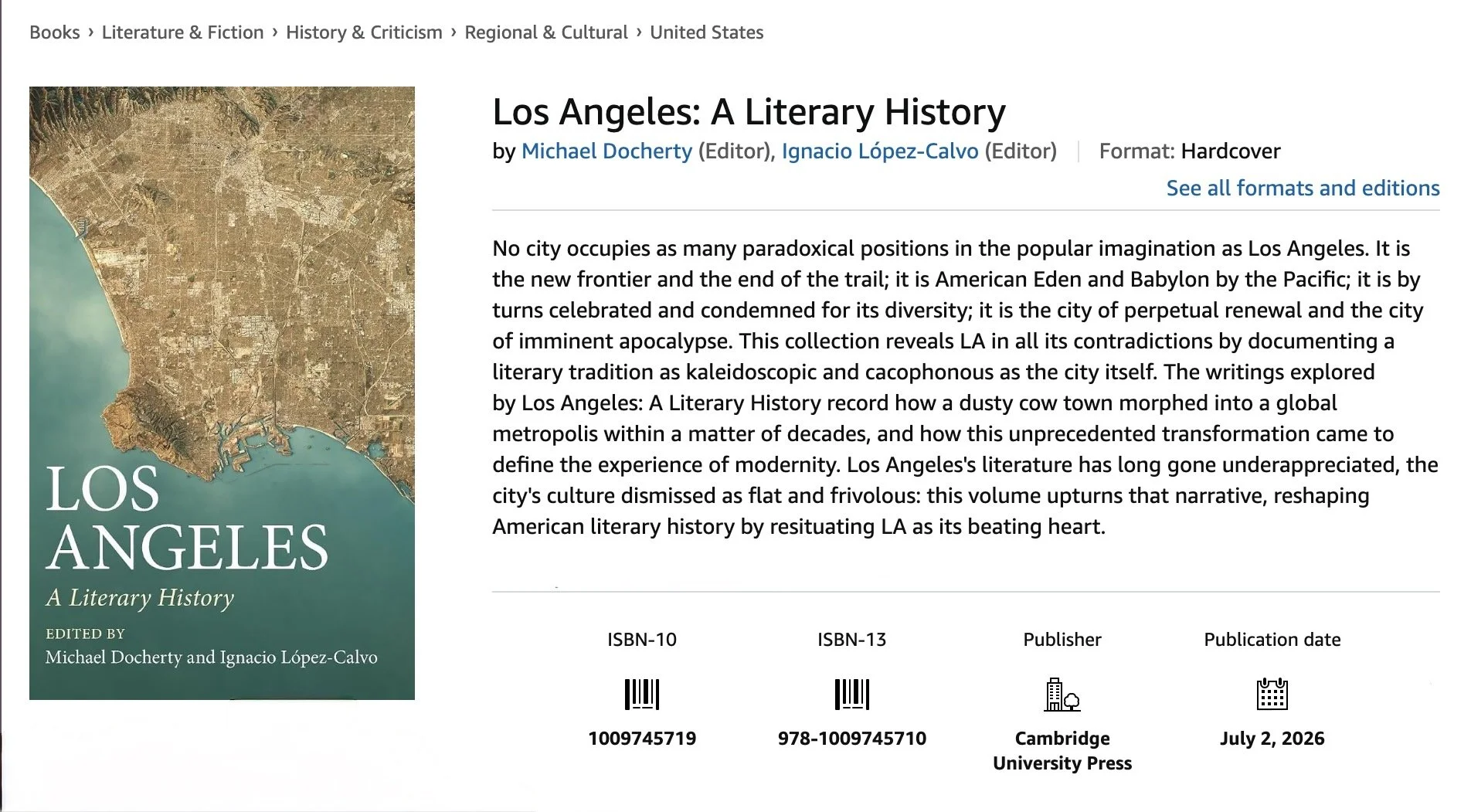
Los Angeles: A Literary History | Cambridge University Press | July 2026
In this volume, I wrote about Eve Babitz and her contact allergy to hypocrisy and boredom, about Joan Didion and Louis Adamic and Harry Carr, about Jonathan Gold’s passionate map of the city through food, and about Mike Davis and Jon Weiner’s radical account of the sixties on Sunset Boulevard.
My editor, the excellent Michael Docherty, let me write about Angeleno reportage and nonfiction within an essay of my own.
The chapter begins with martinis at the Chateau Marmont with Matthew Specktor, author of Always Crashing In The Same Car . That one came out in 2021, and 2025’sThe Golden Hour is also fantastic. I think of Specktor’s book as a mash-up of memoir and L.A. cultural history—a romance about breaking your own heart against the city’s impossible games.
Los Angeles and its clichéd problems have broken my heart so many times. But in a way, that’s how you get hooked, that’s why you keep coming back. The Cambridge volume aims to resituate Los Angeles at the beating heart of literary history, wherever that is. Maybe heartbreak is the only way to get at the literary truth.
Did you know that Adamic once worked mucking rocks for the HollywoodLand development? In my ideal world, I would teach an entire class about just Adamic—his radical reporting, the prostitute who saved his life, his relationship with H.L. Mencken after the legendary magazine editor plucked him out of obscurity, the mystery surrounding his death. But a world where I could get a class to read hundreds of pages from a long dead radical reporter seems increasingly distant.
-
Our panel at the conference will be “Los Angeles: Literary Histories and Futures.”
I wrote this chapter a few years ago. Cambridge University press actually got hacked and delayed the release. The world of letters was already crumbling, and that was before LLMs exploded across the terrain.
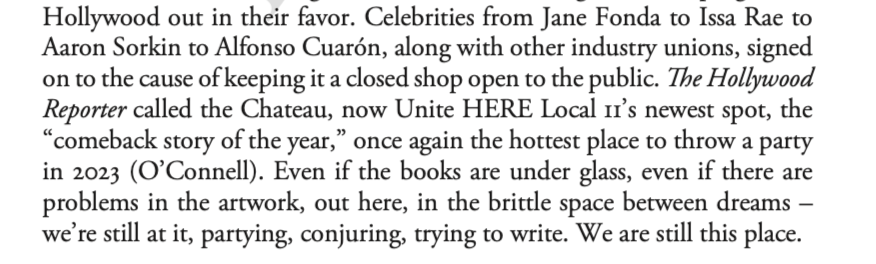
We’ve always had to reinvent, though. Even in the golden years of the movie business, writers hopped between different forms of artistic labor to make ends meet. My theory is that the imagined community of Los Angeles was formed in the space between. Writers in-between gigs wrote a city into being in the interstices. Eve Babitz dated her way to an electric freelance persona. Didion was a screenwriter and a journalist to support a novel habit. Mike Davis was a trucker before the force of his vision and popularity and the New Left Review won him an academic perch. The artistic geography of the city needed these multiple scenes in order to thrive. Since well before the robot takeover, the media ecosystems that supported writers have been getting defunded and destroyed. Literary nonfiction will have to stretch itself across But I tried to end the chapter on a hopeful note. I talked about the Chateau Marmont’s union drive, that turned the stars out and kept the place open to the rest of us…