Calm Can Coexist with Fury: A conversation with Naomi Klein
AT SOME POINT in 1999, I interviewed the author and journalist Naomi Klein about No Logo: Taking Aim at the Brand Bullies, her exposé of the extractive and exploitative realities behind the shiny packaging for Nike and Starbucks. That book, and Klein herself, became central to the anti-capitalist movement that erupted into protests at the World Trade Organization summit in Seattle. It’s hard now, more than 20 years later, to describe thedominant political moodat the time. The sense back then was that the global corporations had won, hands down, and that people would always care more about a new pair of Nikes than about cracking the protective shell of corporate hegemony and neoliberal economic power. Klein’s work played a key role in cracking that shell. She made it all feel less inevitable. She and her book were, as she put it to me, “kind of anointed as the voice of a movement.”
I have a distinct memory of sitting in the lobby of a hotel somewhere in Boston and asking her point-blank: how did she think profound social change might actually come about?
I The weekly newspaper where I was working as a reporter during that initial meeting, the Boston Phoenix, is now gone. A search through its surviving articles in the Internet Archive came up empty. So readers will have to take my word for what I remember of the original conversation. When I asked her how she thought change would happen, she said: only with great social upheaval.
When I spoke to Klein on September 6, in Los Angeles, I didn’t expect her to remember meeting me. But I wanted to tell her that when I was bringing sandwiches to the Occupy L.A. encampment, in 2011, I thought of her. I believed then that the great upheaval might have arrived. Of course, Occupy, like the WTO protest movement (and the Bernie Sanders presidential campaigns, and the Green New Deal), has not brought about as much change as many activists once hoped it would. When I mentioned Occupy last week, Klein asked me if I was going to make her depressed.
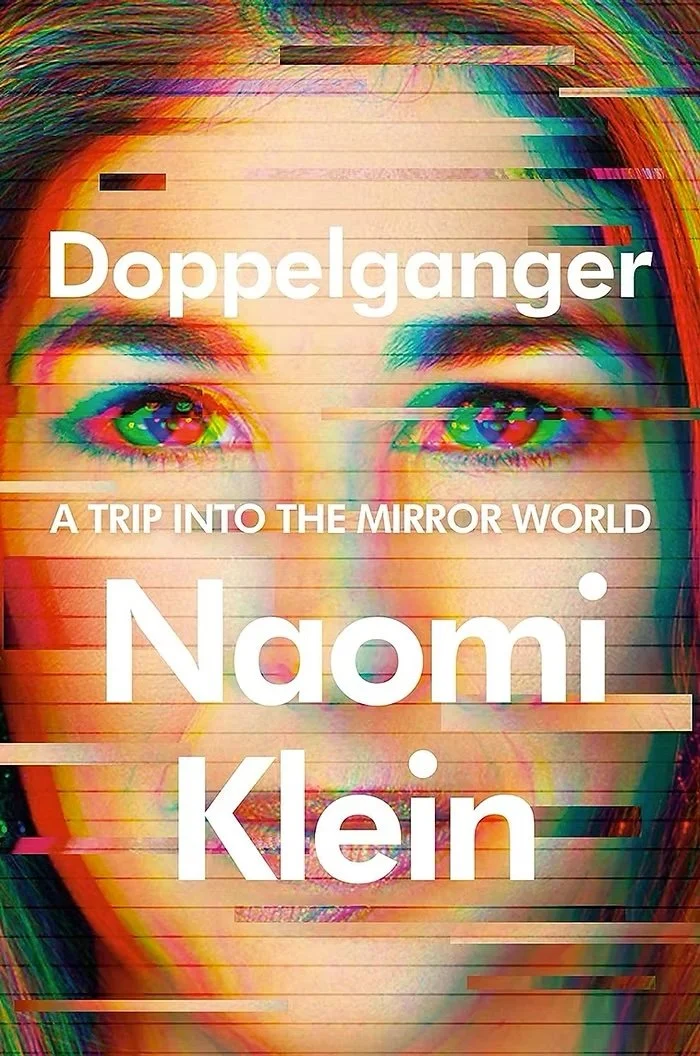
The Left has reason to be depressed, and much of Klein’s new book, Doppelganger: A Trip into the Mirror World, seems to have been written from a place of grief. She touches on this at the end of our conversation here, edited for length and clarity. But the book’s occasion of telling is the strange phenomenon of Klein getting mixed up on social media platforms with her red-pilled dark twin, Naomi Wolf.
In trying to understand Wolf, Klein takes a journey of the soul into North America’s political underbelly. She looks at the twisted ways that so many people have lost the ability to understand each other. But she’s very clear that no one is off the hook; Klein discovers instead that we are all implicated in each other’s messes. One thing I neglected to mention to Klein is that my middle name is also Naomi. There are Naomis everywhere, it seems.
¤
MICHELLE CHIHARA: I don’t want to make you depressed—but there’s a really heavy moment in Doppelganger where you’re talking about the aftermath of your book This Changes Everything: Capitalism vs. the Climate (2014), and coming to grips with the fact that the world has now let a crucial window of opportunity close on turning around carbon emissions. You grapple with what it means to put down your identity as the person offering the solution. You’re not the one exhorting people now.
I was thinking about that—which is maybe a little depressing—but I was hoping that you would say something about using this newer approach, or voice. You’re not exhorting anyone to take action around the story with Wolf, which is odd and funny in so many ways, and yet I think you write it with a lot of compassion. Did you think about this as a way to invite a different group of readers in?
NAOMI KLEIN: I do feel like this is a different kind of book that will appeal to different kinds of readers. I hope there’s overlap with my old readers as well. It’s a weird book for weirder moments. A lot of people I know from movement work also feel very destabilized. They feel a lot of vertigo and confusion, especially around people whom they used to trust and respect, who are now in what I’m calling the mirror world.
I just came from the Haymarket Socialism Conference, which was a great way to start my tour, because I saw so many old comrades from over the years. So I don’t feel like I’m putting the people whom I’ve been in conversation with my whole adult life aside, in favor of trying to reach other readers. But this book is more personal. It’s kind of creative nonfiction and doesn’t put its politics in the window, so to speak. So there’s a part of me that does see the book—don’t tell anyone—as a little bit of a Trojan horse? I mean, it’s a doppelgänger book, and doppelgänger books always start out as being about the Other, about an attempt to defeat the double—but then they end up being a mirror. The doppelgänger story always ends up being about a new way of seeing oneself.
“And education, foundationally, has to be about that sense of possibility—that it is possible to change, that non-elite people have changed the world before. That’s the most important education I think we can do—more than saying, Hey, the actual content of this is really alarming.”